
Sustainable IT: Turning E-Waste Management into a Competitive Advantage
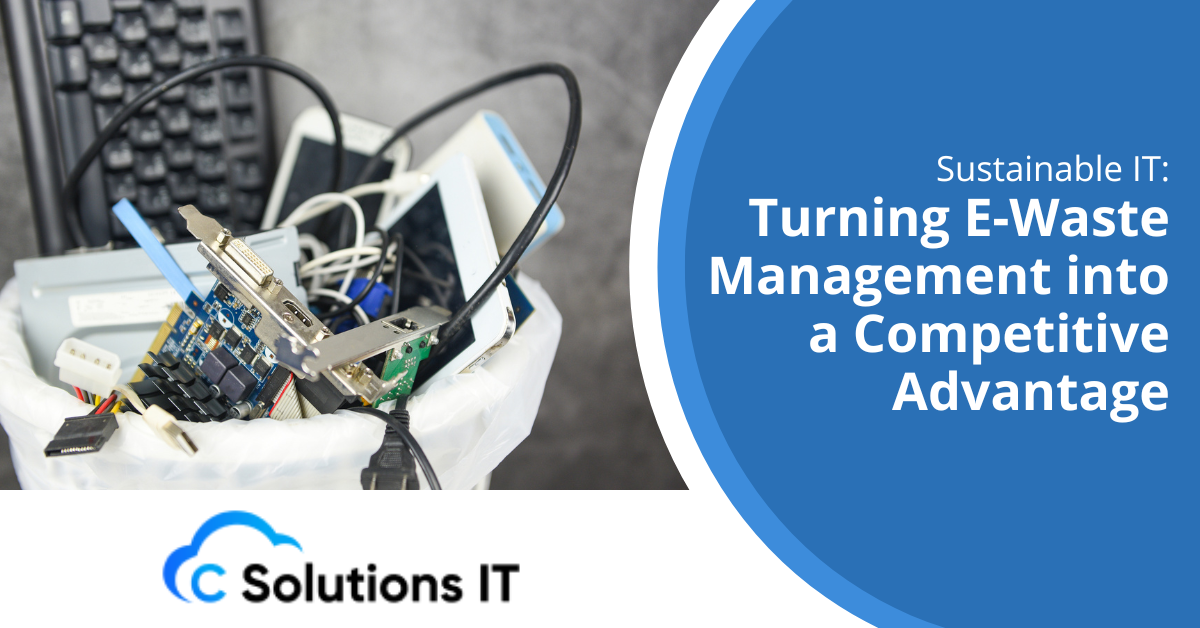
Article summary: E-waste management for businesses is becoming a measurable advantage because it reduces data risk and improves lifecycle planning. It also creates documentation customers and auditors can trust. Global e-waste is rising quickly, yet only about one-fifth is formally collected and recycled. That makes responsible disposal more important than ever. The strongest approach combines predictable refresh planning with secure IT asset disposition (ITAD). It uses recognized sanitization standards and verified recycling. Done well, it lowers emergency IT costs, protects sensitive data, and turns “old devices” into proof of operational maturity.
If you want to find risk in a small business, don’t start with the firewall. Start with the shelf.
Old laptops “we might need someday.” A retired hard drive in a drawer. Phones from former employees. A box of equipment that’s been through two office moves and still hasn’t been dealt with.
That pile isn’t harmless clutter. It’s unmanaged data, unmanaged access, and unmanaged responsibility.
That’s why e-waste management for businesses is becoming more than a sustainability goal in 2026. Done properly, it’s a repeatable process that reduces security exposure, makes refresh cycles more predictable, and gives you documentation you can stand behind when customers or auditors ask how you handle retired technology.
E-Waste Isn’t Just a Sustainability Topic Anymore
Global volumes are climbing quickly, and the gap between what’s generated and what’s properly handled is still huge.
The ITU’s Global E-waste Monitor 2024 reports 62 billion kg of e-waste generated in 2022, with only 22.3% documented as formally collected and recycled. That means most discarded tech is either unmanaged, informally processed, or simply untracked.
The WHO’s e-waste fact sheet reinforces why this matters beyond optics. E-waste isn’t just “old hardware.” It can involve toxic materials and unsafe handling in informal recycling and dumping, which creates real health and environmental harm.
How Better E-Waste Management Becomes an Advantage
It Reduces Security Risk with Proof, Not Promises
Retired devices often hold more data than people realize. When that equipment leaves your control without a defensible disposal process, you’re betting your business on “ it’s probably fine.”
A stronger approach follows a recognized sanitization standard and produces documentation you can stand behind.
NIST lays out exactly what “defensible” looks like in its media sanitization guidance, including different methods depending on risk and whether the device will be reused.
It Lowers Emergency Spend and Turns Refresh Into a Plan
Disposal gets messy when replacement is reactive. That same reactive pattern also drives emergency IT support and downtime.
Building a steady lifecycle plan reduces fire drills and keeps old equipment from piling up in the first place.
It Creates Measurable Environmental Impact
There’s a real difference between “we care about sustainability” and “we can show what happens to our retired tech.”
The EPA’s electronics donation and recycling guidance provides concrete examples of why responsible recycling matters, including the recovery of valuable materials and major energy savings at scale. Pair that with the scale problem the ITU documents, rising global e-waste with relatively low documented recycling, and it’s clear why businesses that handle e-waste responsibly stand out.
Stop Creating Surprise E-Waste
The most effective way to address e-waste is to eliminate unplanned accumulation. In SMBs, e-waste rarely results from deliberate refresh cycles.
That’s why e-waste management for businesses starts earlier than recycling day. It starts with lifecycle planning.
When replacements are scheduled, you can control what gets retired, when it gets retired, and how it gets disposed of. You also avoid panic buying and reduce downtime.
At a high level, a “no-surprises” approach looks like this:
- Keep a basic device inventory
- Refresh on a predictable schedule instead of waiting for failure
- Assign ownership so “retired device handling” doesn’t fall through cracks
Secure IT Asset Disposition (ITAD)
Once devices are ready to leave your environment, the goal changes from “get rid of it” to “prove it was handled correctly.” That’s the difference between basic recycling and true e-waste management for businesses.
Secure IT Asset Disposition (ITAD) is the process of retiring hardware in a way that protects data, documents, and ensures devices are either reused responsibly or recycled properly.
At a high level, effective ITAD includes:
- Inventory and chain of custody
- Data sanitization
- Verified downstream handling
- Documentation
NIST 800-88
Most businesses don’t run into trouble for trying to dispose of devices responsibly. They run into trouble when they can’t prove what happened to the data.
The NIST gives you a shared language for what “sanitized” actually means, and it helps you choose the right method based on risk and reuse.
At a high level, NIST describes three common outcomes:
- Clear: Basic techniques that remove data from user-addressable storage. This can be appropriate when risk is low, and the device will stay under your control.
- Purge: Stronger techniques that make data recovery infeasible even with advanced methods, while potentially keeping the device usable for reuse or resale.
- Destroy: Physical destruction that renders the media unusable and makes data recovery infeasible.
Two details matter most for SMBs.
First, sanitization isn’t simply wiping a device and moving on. NIST stresses the importance of verification: checking that the sanitization was successful and repeating the process if it didn’t achieve the intended result.
Second, documentation is part of the security value. NIST includes examples of the kinds of records organizations should keep such as the method used, what asset was sanitized, when it happened, and the final disposition.
That’s the difference between saying “we wiped it” and being able to prove it.
Make E-Waste Management a Business Advantage
Sustainable IT isn’t about making a one-time donation run or clearing out a closet once a year. It’s about building a process you can repeat and defend.
When you treat e-waste management for businesses like an operational workflow, you get three wins at once. You reduce the risk of retired devices leaking data. You replace equipment on purpose instead of in emergencies. And you can prove what happened to each device, which builds trust with customers, auditors, and partners.
C Solutions IT can help you build a lifecycle plan that brings predictability to device replacement, along with an ITAD workflow that clearly documents where devices go and how data is handled. To get started, contact us today.
Article FAQs
What is e-waste management for businesses?
E-waste management for businesses is the process of tracking, retiring, sanitizing, and disposing of old technology in a repeatable way. It covers the full lifecycle so devices don’t become a security or compliance risk.
What documentation should we keep for audits or customers?
Keep an asset list, chain-of-custody records, and proof of sanitization or destruction. If you use a partner, retain certificates of sanitization/destruction and recycling documentation.
What can companies do to reduce e-waste?
Reduce e-waste by planning refresh cycles, standardizing equipment, and extending device life where it’s safe and supportable (repairs, upgrades, reassignment). You can also prioritize reuse through refurbishing or donation when devices meet security and support requirements.